
The Importance of Crisis Planning for Public Agencies
By Tanya Mannes Castaneda, APR | July 9, 2026
Most crises don't appear out of nowhere.
People say things.
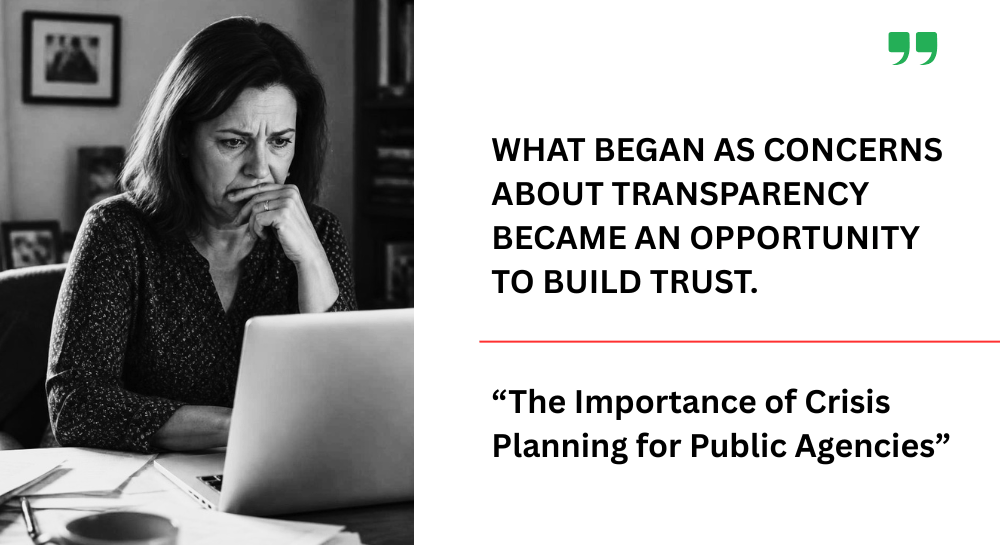
A resident sends an email to a public agency about a proposed project in her neighborhood, saying: “Why are you hiding this from the public?!”
Here’s what led up to that email.
A postcard had been sent out to residents within 500 feet of the residential project, which was proposed to be taller and more dense than other homes in the neighborhood. The resident lived on the same street but never received a postcard – so she only heard rumors from her neighbors. As she awaited information and saw nothing on the TV news, she became increasingly frustrated. She thought about emailing a reporter to suggest an investigative story. She even contemplated starting a petition to protest what she saw as the public agency’s lack of transparency.
Finally, she sent that email to the general inbox of the public agency.
That email was just one example of the warning signs that government and public agencies ignore at their own peril.
Other examples of warning signs include public comments at meetings, employee complaints, stakeholder questions, and social media activity. While not every challenge becomes a crisis, many organizations can look back and identify moments when an issue first started taking shape.
The organizations that navigate these situations most effectively are rarely the ones scrambling when a headline appears. They are the ones who have already considered potential risks, established decision-making processes, and prepared leaders to make decisions and communicate with the public.
Today's communications environment moves quickly. Information spreads instantly, stakeholders expect timely updates, and misinformation or speculation can shape public perception before all the facts are known. With that in mind, today’s crisis planning should include a strategy to monitor social media chatter on a variety of platforms, including Facebook, TikTok, Instagram, Bluesky, Reddit and X, to name a few.
At the same time, leaders are often asked to make decisions and communicate while details are still emerging.
Readiness Is More Than a Response Plan
Many organizations think about crisis communications as something that happens after a problem occurs.
Crisis readiness is not about predicting every possible scenario. It is about understanding vulnerabilities, evaluating risks, and ensuring leaders and teams are prepared to respond when challenges arise.
Proactive organizations regularly ask:
What issues could generate public concern?
Which audience would be affected?
How might stakeholders view this situation?
Is our communications team prepared?
Are leaders prepared to respond publicly if needed?
These conversations are far more productive before an issue becomes urgent.
Effective preparedness creates alignment among leaders and teams, so organizations can focus on addressing the issue rather than determining who should do what.
This approach is the foundation of PRM Consulting's Crisis Anticipation & Readiness System™ (CARS), which helps organizations identify vulnerabilities, prepare leadership, and build practical frameworks for navigating sensitive issues with confidence.
In the case of the resident sending an email, the public agency had processes in place to forward “red flag” emails from the general inbox to leadership. The executive director of the organization received it and took it seriously – convening a staff meeting to discuss the resident’s claim.
The team considered the question: “Is it possible that our notification process broke down?”
They examined their process and who had received postcards. They reviewed incoming emails to determine whether other residents had raised similar concerns. Finally, they performed a scan of social media to identify other chatter about the project.
By aligning the team around shared information, a Public Information Officer (PIO) was able to speedily contact the resident, offer information and provide an update on the proposed project – including future opportunities for public input. Additionally, during the conversation, the PIO verified that the resident did not live within the legally required notification area. When she was informed of this, she understood why she did not receive a postcard.
Step Into the Opportunity of Your Crisis
Most leaders would never describe a crisis as an opportunity, and understandably so. Crises can be disruptive, stressful, and highly visible.
Yet difficult moments often shape how an organization is remembered. And public agencies have a higher responsibility to earn the trust of their constituents.
The resident who reached out to the public agency was looking for information. But more importantly, she was looking for someone to signal responsiveness and transparency. By speedily addressing her concerns, the public agency built trust. The resident agreed to be added to mailing lists for future communications.
She didn’t call the reporter about an investigative story.
She didn’t start a petition.
Even more importantly, the public agency earned trust with the resident, who committed to informing her neighbors about the status of the proposal.
Overall, this was a win – a crisis was averted before it could take shape.
When leaders communicate clearly, a difficult situation can become a defining moment for an organization's reputation. The goal is not simply to get through a crisis. It's to emerge with stronger relationships, greater credibility, and deeper trust than before.
Your trusted partner.
Expert land use, entitlements, crisis communications, public relations and community engagement services.
© 2026. All rights reserved.